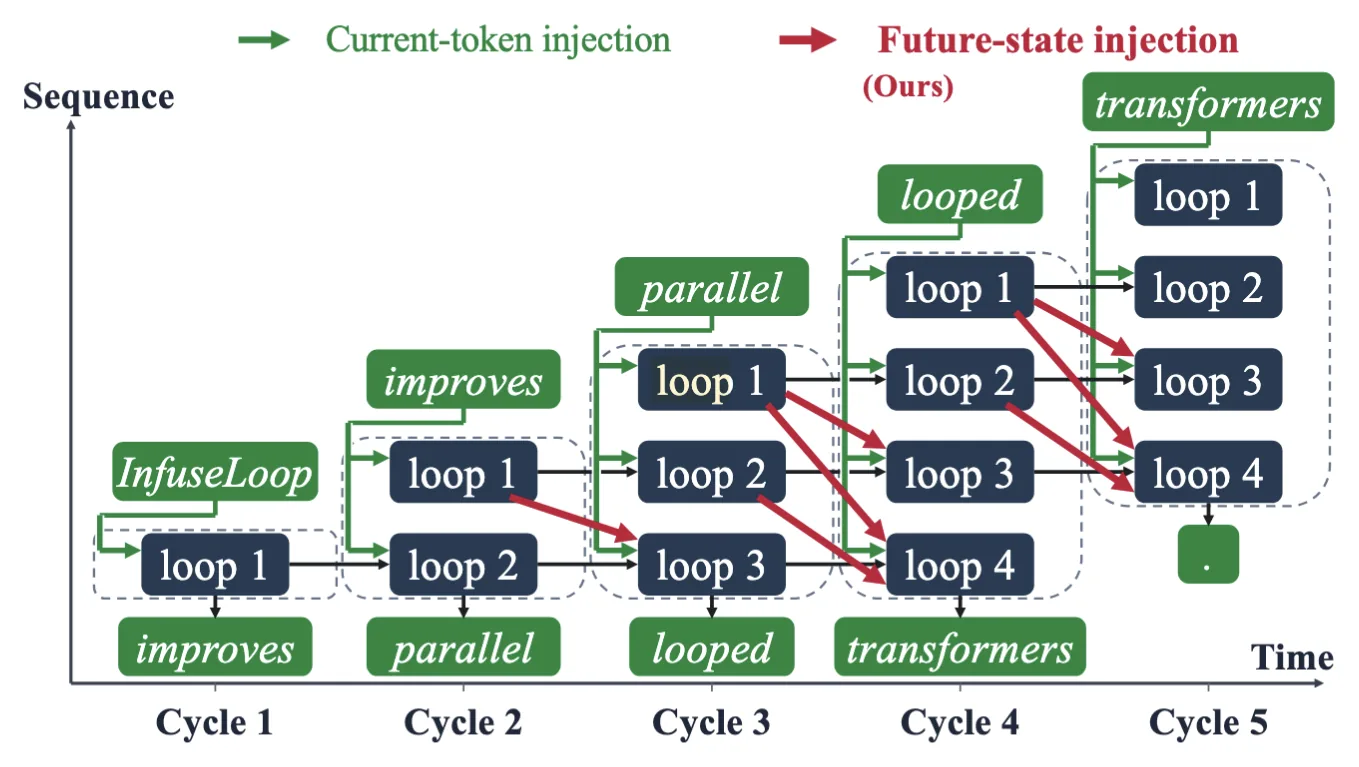
We find that Parallel Looped Transformers (PLTs) scale poorly with depth because only the preceding in-trajectory state crosses loop boundaries, even though completed cross-trajectory representations are already available.
Method: InfuseLoop, a cross-trajectory latent injection that aggregates causally available hidden states from later prediction trajectories via lightweight attention residuals
Efficiency: preserves token-parallel training and concurrent loop execution with only O(Rd) extra hidden-state storage and the same logical KV-cache footprint as vanilla PLTs
Result: eliminates training-loss spikes and improves validation-loss scaling up to 8 loops, cutting perplexity by 3.4–17.1% over vanilla PLTs and 10.5–37.3% over the non-looped baseline, with +0.84 / +1.99 points average downstream accuracy at only 0.3% extra decoding time over vanilla PLTs.
Preprint
Looping Deeper Without Growing the KV Cache: Recurrent Depth for Causal Encoder-Decoders
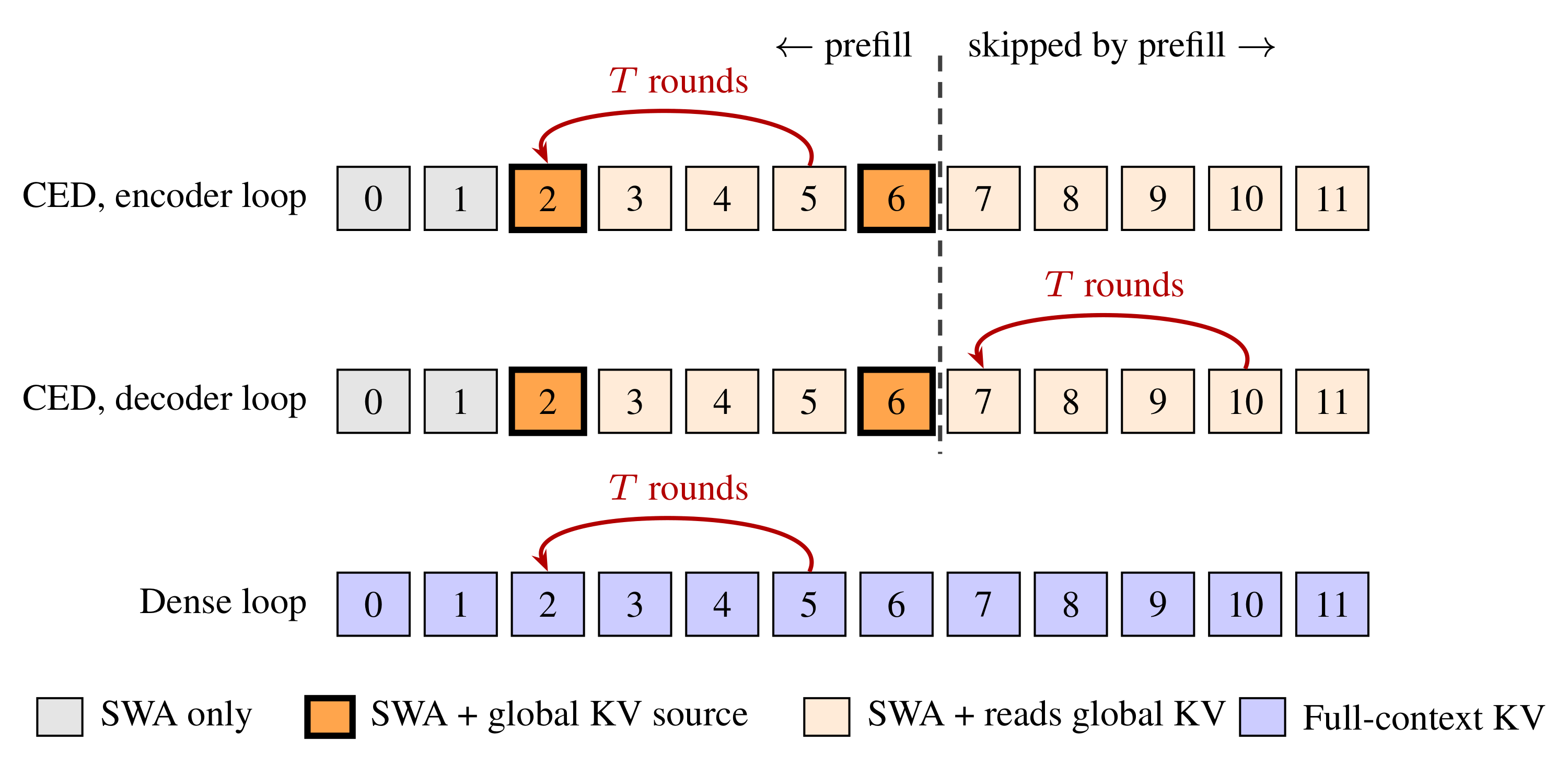
We design a looped causal encoder–decoder (CED) that gains recurrent depth with zero round-wise KV cache growth.
Key findings:
recurrence belongs in the encoder, iteratively refining global KV rather than re-reading static decoder projections
training under stochastic recurrence depth yields a fixed point where every round losslessly shares the last round’s KV cache
Result: matches an unlooped CED’s minimal memory footprint and recovers 86–93% of a looped Transformer’s gain with 1/6 of its global KV
At scale: looping the 552B-parameter DeepSeek-V4.1-Flash for 8 rounds on one 4×GB200 node holds 36.8× less KV per token, fits 38 128K-token requests, and serves 3.6× higher throughput on 8K-token prompts.
ICLR 2026
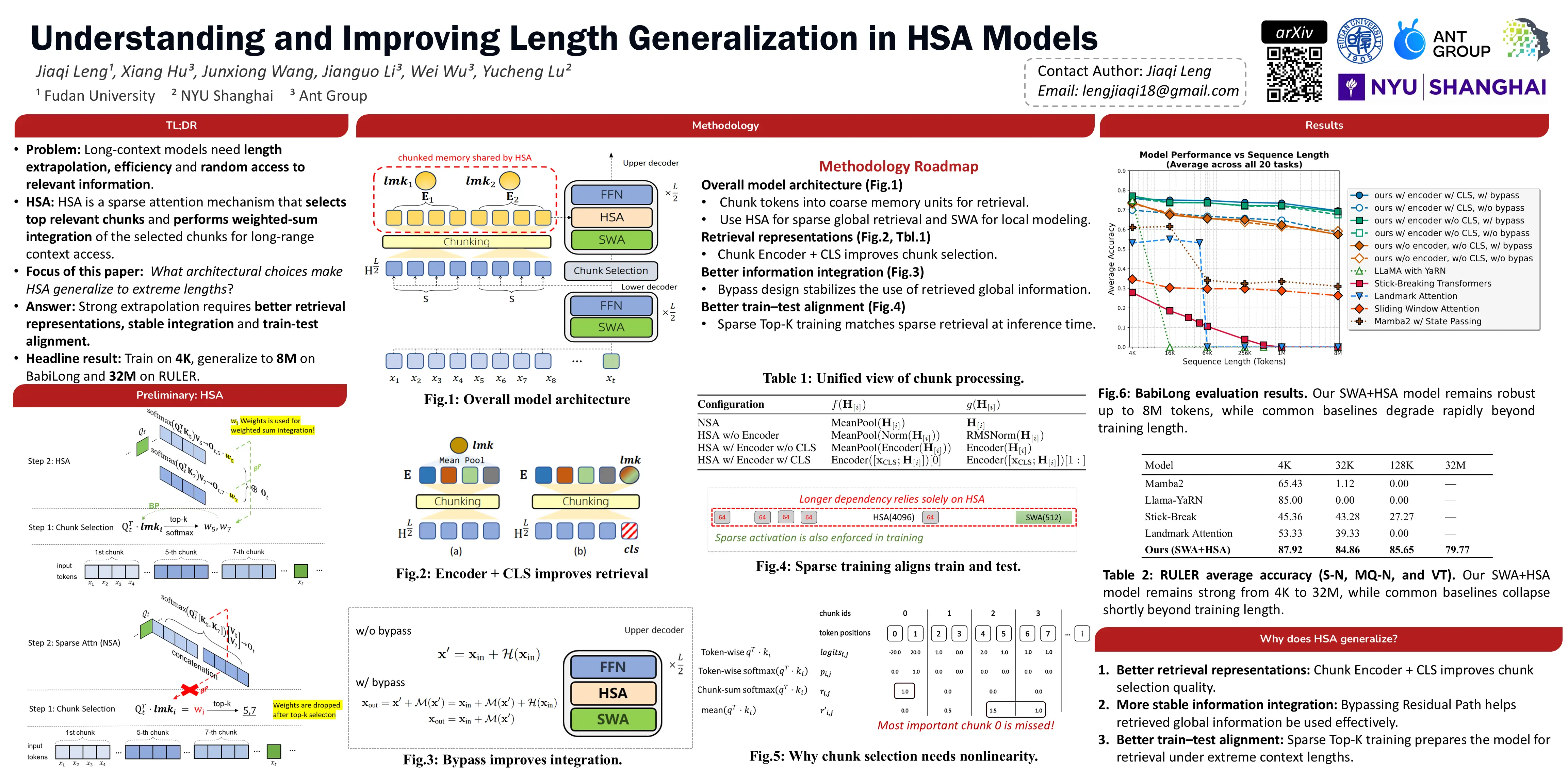
Understanding and Improving Length Generalization in Hierarchical Sparse Attention Models